
A Mini Guide To Breaststroke Swimming And Its Benefits
Thanks to its relative simplicity, stability, and wide accessibility, it’s no wonder that breaststroke is currently the most popular stroke in the UK and the rest of the world. Because the technique entails working your arms and legs in tandem and performing long glides, breaststroke is suitable for swimmers of all levels. Moreover, since it works your limbs pretty hard, the stroke constitutes a great alternative for everyone who’s looking to tone their arms and legs.
The History of breaststroke swimming
The most popular recreational swimming style, breaststroke is a technique believed to have roots in ancient times. In fact, archeologists have uncovered several paintings depicting people performing a similar movement near Wadi Sora in Egypt’s famous ‘cave of swimmers’. An interesting fact about this technique is that it was the only stroke allowed during the great plague during the Middle Ages; because the swimmer’s head is out of the water most of the time, people back then believed it would limit the evolution of the epidemic.
Breaststroke swimming became highly popular during the Victorian Era, perhaps the only time in medieval history when England knew prosperity, refined sensibility, and peace under the rule of Queen Victoria. Refined sensibility constituted the emphasis of these ages, as people back then considered the overarm action in swimming as inelegant and unsuitable. However, the breaststroke only managed to become competitive in 1875, soon after the famous Captain Webb became the first man to swim the English Channels.
Breaststroke may be easy, but also tricky
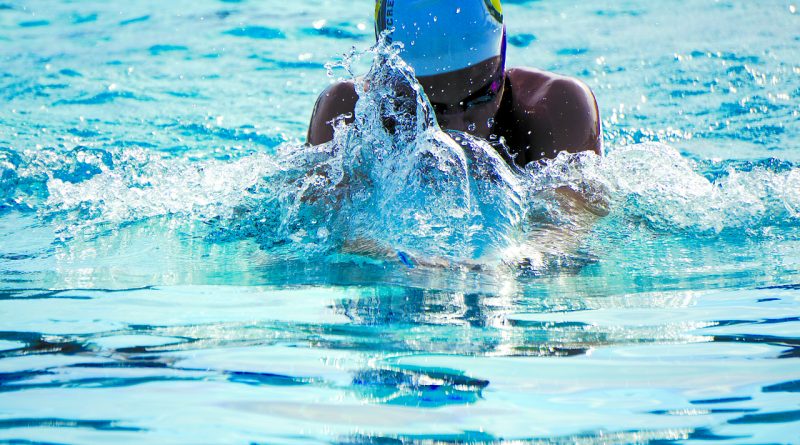
Although it’s relatively simple to perform, the truth is that few swimmers are able to execute breaststroke in a manner that promotes the good use of their entire body. The problem for most comes from taking the idea that ‘breaststroke is the best means of keeping your hair dry’ too seriously. In spite of the fact that the technique allows you to keep your head out of the water most of the time, it doesn’t mean ALL the time.
In fact, by attempting to do so, you will put too much pressure on the spine and risk a serious strain. On the opposite end, if you maintain your face in the water for too long, then you will be too busy trying to breathe and hence, less focused on your arm and leg action or timing.
Sometimes, swimmers are unable to perform the breaststroke correctly because they picked up some bad habits during their childhood. In the latter case, the best method of correcting these strongly ingrained habits is to re-learn the stroke.
The key features of breaststroke swimming
Breaststroke swimming is best learned gradually. After you manage to attain effective arm and leg coordination, you can move on to a more complex synchronization of your limbs as well as breathing integration. Re-learning or learning the technique entails working on:
- Orientation
You should keep your eyes straight down during the glide when your neck is fully extended when your chin rests near the surface of the water and in the breathing position.
- Arm action
When you are in the initial gliding position, try to keep your arms slightly downwards. During the propulsive movement, you should focus on holding the water so your upper body is drawn forwards and upwards. Don’t force too much in the opening phase while your upper back widens.
- Leg action
Take note that the leg action is non-propulsive for breaststroke: simply release the legs before pushing backward. To prevent knee injury and improve your hips’ mobility, it would be wise to go for a wide, wedge-like action.
- Rhythm
In the event you rely on breaststroke for competitions, then know that long glides are a waste of time. Because the primary objective is to move into the propulsive actions as soon as possible, a far better approach consists of a series of slides with active movements. This way you will have more time to exhale.
Breaststroke swimming is slow but effective
If you want to tone and shape your legs, then a leg-dominant stroke like the breaststroke is ideal for the task. Although it is perceived as the slowest stroke, the truth is that the technique burns the most calories, strengthens your quadriceps, and toughens your hamstrings. All in all, breaststroke swimming provides you with a full-leg workout in a meditative and calming manner thanks to the gentle breathing repetitions.